Saturday, 9 August 2025

A bumper catch on 3/8/25

What a day! We started early, meeting at the Discovery Hut at 0430hrs for our 3rd attempt to catch Sand Martins in front of the Sand Martin bank. Unlike on the previous sessions, as we walked the nets out in front of the bank, very few birds emerged from the holes into the nets. As it was so quiet & there were seven of us (the most for years!), we decided to set some nets in the reed bed where we'd caught well a few days earlier. 

We planned to set six nets in the reeds, but after one quiet round, numbers started to increase & we never managed to put up the sixth net. Meanwhile, the Sand Martin catch also improved, with plenty of re-traps. 

The team in full flow...minus Doug who was watching the Sand Martin net

As usual, we didn't leave the Sand Martin net up for too long to minimise disturbance. Despite the quiet start, with only five or six birds as we walked in, we ended up with a total of 52 birds from the bank net, 35 adults & 17 of this year's young, all re-trapped birds apart from one adult & one juvenile.  Presumably the youngster had come in to roost from another colony as we're pretty sure we've ringed all the young hatched in the wall. Later in the day we also ringed one brood of four pulli (nestlings), things are definitely slowing down in the wall!.

The young birds caught that had been ringed as pulli in the nest had been ringed between 6/7/25 & 17/7/25, so quite a short window.  It was interesting that some of the young were captured together with their siblings, presumably as they were leaving a nest hole as they were extracted from the wall side of the net. Unless there's a reason to suspect that the young from a nest box haven't fledged, when completing nest records, an empty box is usually shown as a successful outcome. It was particularly nice therefore to catch APC2977-APC2980 together, which is the whole brood ringed (by me!) from box G28 on 13th July, proof that that particular brood had indeed fledged successfully.  At least two of the young were still using the nest box on 24th July, but had fledged by 31st July. Interesting to see that they are staying together & roosting in the bank, although we can't say for sure that they're still using G28. 

The brood in G28 on the day of ringing (13/7/25)

Two of the brood still present 24/7/25

We've also had our first Sand Martin that was ringed as a pulli re-trapped elsewhere. Although this was some time ago, it doesn't seem to have made it onto any previous blog post. The bird was ringed on 22/6/25 & caught at Dungeness Bird Observatory on 21/7/25.

From the Dungeness Bird Observatory X feed

Two other birds were caught in the Sand Martin nets, a Sedge Warbler & a Kingfisher. As Doug was constantly monitoring the nets, he saw the Kingfisher fly across the pond & into the net. His description: "it came in like a bullet & almost looked like it was heading for one of the holes!". A quick check on Google revealed that although not common, Kingfishers are known to predate Sand Martin nests, taking eggs & young. We have had a couple of missing eggs & young from the wall, so maybe a Kingfisher was responsible, although probably not this one as it was a youngster....unless it had learned the trick from its parents having been fed them as a chick!

Kingfisher....dark breast band & dark tops of its feet indicate a young bird (age code 3)

Lack of pale area on lower mandible indicates a male

Meanwhile, the nets in the reed beds were getting very busy, with plenty of Sedge & Reed Warblers & Chiffchaffs migrating through, plus a good variety of other species, mostly young birds hatched this year. The juveniles included two more un-ringed Sand Martins, like the one from the wall, presumably a visitor from another colony. 

At first glance this Chaffinch looks like a female, which is duller than the male. However, a closer inspection shows some brighter pink feathers appearing on the breast, growing as part of the post-juvenile moult, when the bird replaces the feathers grown in the nest with the adult type.

Chaffinch, a young male (age code 3J...still mostly in juvenile plumage)

Brighter pink breast feathers indicating this is a male Chaffinch. 

We also caught a young Robin moulting into its adult red breast. It had also moulted its juvenile inner Greater Coverts & was replacing them with the adult type which at the moment are just small tufts emerging from the feather sheaths, otherwise known as being 'in pin'. Often the juvenile Greater Coverts have distinct orange coloured 'thorns' along the shaft (see post on 26/9/24). However, this bird only has a very small amount of orange at the tip, so the background colour of the feathers will be more important for aging this bird once it's finished its post-juvenile moult. 

Robin undergoing post-juvenile moult, changing mottled feathers for red ones


Juvenile Robin wing

We also caught several young Goldcrests. The one pictured below was still mostly in juvenile plumage but was starting to grow its crest...which looks orange indicating that it's a male. 

Goldcrest growing its crest

We also caught three 'controls' ie birds ringed elsewhere.
  • A juvenile Reed Warbler ringed at Teifi Marshes in Ceredigion Wales on 9/7/25. 
  • A Chiffchaff that had been ringed further up the Axe Valley at Colyton Sewage works by Mike Tyler on 22/7/25.  
  • A juvenile Reed Warbler ringed at Oxwich Marsh, Swansea , Wales on 10/7/25
Also, one of our juvenile Sedge Warblers that was ringed on site on 1/8/25 & re-trapped on 3/8/25 was then caught by the Swale Ringing Group at Spitend Marshes, Kent on 6/8/25. 

One unusual incident of note occurred mid morning. Two Roe Deer were seen running into the reed bed. On reaching the far net, it was found lying flat on the ground, with a guy & peg stuck high up in a tree on the far side of a stream. A large deer-sized hole was also found in the bottom shelf. Luckily the few birds in the net survived unscathed. 

It had been a long, exhausting & productive session. Although we'd started with seven of us, numbers gradually dwindled as people had to leave, and for the last few hours it was just Neil, Jan & myself, catching the last birds at 1500hrs & finally leaving the Wetlands at about 1600hrs having processed 217 birds!

The weary die-hards! Seemed silly to stop whilst we were still catching!

Results for the reed bed:


Ringed

Re-trapped

Control

Blackbird


3


Blue Tit

6

3


Cetti’s Warbler

3

1


Chaffinch

3


Chiffchaff

13

2

1

Dunnock

2

1


Garden Warbler

1


Goldcrest

3


Goldfinch

5


Greenfinch

9


House Sparrow

5


Kingfisher 

1


Reed Bunting 

2


Reed Warbler

33

5

1

Robin

2


Sand Martin

2


Sedge Warbler

31

6

1

Song Thrush

1


Whitethroat

1


Willow Warbler

6

1


Wren

5

1


134

23

3

Tuesday, 5 August 2025

Summer Shows 2nd August

The group attended two summer shows which coincidenally were held on the same afternoon. One was at Uplyme where Mike Tyler and Robin Pearson manned our stall and the other was at Whitford where Ian Stanbridge and Dan Montgomery represented us. These events are an opportunity to talk to members of the community who might otherwise not know anything about bird ringing. We were assisted in promoting the AERG this year by our recent appearance on Countryfile!
Our exhibits at the Uplyme Show
The MP for Honiton Richard Foord was in attendance at the Whitford Show. He was obviously impressed with Ian and Dan because his social media featured pictures of our stall and a link to the group!

Monday, 4 August 2025

Ringing at the Wetlands 1st August

A small team of three, Ian, Sue and Robin, undertook a ringing session around the Discovery Hut. We ran five nets – two in the scrub and three in the reeds – and caught 73 birds. Recent sessions in this area have produced a good number of reed warblers and so it continued, with 30 birds caught. Of these we aged 19 as this year’s birds (age codes 3 or 3J), nine as adults (age code 4) and two birds didn’t show sufficient features for us to decide how old they were (age code 2). So there were twice as many young birds as adults and this is what we’d expect towards the latter part of the breeding season when young birds are dispersing. It was good to ring and process a garden warbler and a linnet, neither of which is a frequent capture here.
The garden warbler and the wing of the linnet showing a moult limit which makes this a young bird: the older juvenile feathers (marked) are shorther and darker and are being replaced by the longer browner adult feathers. We caught five willow warblers which showed a wide range of body colouration, from the lovely lemony yellow that is typical of this species to the rather drab buff more typical of their close relative, the chiffchaff, of which we caught nine.
One of the yellower willow warblers.
of the nine chiffchaffs caught, one - the bird above - was a control and had been ringed in Spain. More details of exactly where and when it was ringed when we have them.
This is a wren which is this years bird. The lines on the primary feathers are arraged in neat rows showing that the young feathers all grew at the same time, unlike the chequered pattern in an adult where the feathers have been variously replaced. This bird also shows no white under-tail coverts that would be present in the adult
This is a young greenfinch. The striated breast and belly are typical. The wing shows the pristine feathers of a young bird and the lack of yellow on the primaries tells us that its a female

Sunday, 3 August 2025

Three days of ringing activity - 17th-19th July

 After a considerable delay in our blogging we have a report from three sessions carried out on the 17th, 18th and 19th of July.

17th July

This was our weekly session working behind the sand martin colony.  This involves the checking of the nesting boxes to monitor activity and record the progress of nests for submission as nest records. This is predominantly carried out by the indefatigable Doug who uses an endoscope to check each of the nests. Several of us join him on each session to ring any pulli ready for rings.  This time we ringed a total of 33 nestlings from 8 of the boxes.  

18th July

We made a very early start trying to catch more adult sand martins in front of the sand martin bank at the Seaton Wetlands.  A team of ringers set out very early to set the nets before dawn.  We were soon catching birds and had a total of 68 birds.  

The team at work

22 of these were new birds, all of which were adult birds.  The remaining 46 retraps were all mostly adults, with only seven captures of this year's juvenile birds.  This fits very well with the idea that the young birds only stay around the colony for a short while and then roost away from the colony and so are not caught in the early morning.

Processing one of the sand martins


19th July


We set out again with intentions to do some general mist netting in the hope of catching our resident reed warblers, but also some migrating warblers.  The Wetlands sees good numbers of sedge warbler and willow warbler stopping on passage south for the winter.  

The weather was not ideal so we made our base in the Discovery Hut. This is used by the Wetlands as a focal point for visitors and has been designed with ringing demonstrations in mind and has displays and information for visitors as well as refreshments for thirsty ringers! This meant that as the morning wore on we attracted a number of visitors who we share our activities with. We try to inform about our activities, the birds that we are studying and about the Wetlands as an important local nature reserve.

Yours truly showing one of the birds to the public...


... while Dan gets ready to process another.

The mornings ringing proved very successful. We had a total of 75 birds, with good numbers of reed warblers with 16 new birds and 12 recaptures.  Sedge warblers ran the reed warblers a close second, with 22 news birds and 1 retrap.  Many of these sedge warblers were carrying large deposits of fat. This year so far, ringing in the same areas on a number of occasions, we have caught only two sedge warblers. These suggest these birds are on passage and heading south for the winter.

We also caught four juvenile stonechats indicating that there has been successful breeding on the reserve. 

One of the stonechats...

Other interesting birds included five sand martins and a house sparrow.  The sand martins were four unringed juvenile birds, which we presume are birds also on passage or local birds from other colonies prospecting the surrounding area, and one juvenile from the bank. While we do catch house sparrows on the Wetlands they are generally not in the area we were ringing on this occasion so this was a nice record.  Hopefully there will be more!

... and the house sparrow.

And we caught a blackcap which had begun a main moult of its flight feathers, providing an excellent training opportunity.

Two new primaries about half grown, one just appearing from pin and the rest are old primaries

We also caught a kingfisher which, as always, drew an admiring audience from those people nearby at the time and so generating a great deal of interest from members of the public.  

The total of birds for the session was

Species                 New birds               Retraps
Reed Warbler               16                         12
Sedge Warbler              22                          1     
Blue Tit                         3                           1
Stonechat                      4
Cetti’s Warbler              3
Sand Martin                  4                           1
Chiffchaff                      1
Willow Warbler             2
House Sparrow              1
Blackcap                       1
Reed Bunting                1
Kingfisher                     1
Wren                             1


Sunday, 27 July 2025

Gull ringing on the Breakwaters of Portland Harbour, Dorset

A project organised by The Radipole Ringing Group and heavily supported by the AERG on the North Eastern and Outer Breakwaters in Portland Harbour targeting the Great black-backed Gulls (GBBGU) and Herring Gulls (HERGU) and with kind permission of the Portland Harbour Authority.

The scheme is registered with the British Trust for Ornithology (BTO) and was begun in 2011. 


A challenging environment


The project, begun by Terry Coombs and Steve Hales, is now run by Guy Hayden and Doug Rudge. In more recent years we have carried out Nest and Egg surveys before the ringing season. This year we found 317 nests, 622 eggs and 114 pulli, we were late with the second survey as weather got in the way and hence a significant number of pulli instead of eggs! At this stage the pulli are too small to ring. Incubation is around 27 days and then it is between 49 to 56 days from hatching to fledging. We gathered some interesting egg weight data. (For the analysis you will have to see our end of year report.) The breeding productivity is reported to be around 1. 

Eggs being weighed

A hatching!

Pulli too young to ring

In the ringing season, from late May to early July, we fit both BTO and Darvics to pulli  of the GBBGU and HERGU. This years totals were 91 GBBGU, 28 HERGU, 2 Oystercatchers, 36 retraps or sightings of this years pulli, and 5 Sightings of adult GBBGU returned to the Breakwaters. The pulli are very difficult to find once they have left the nest. 

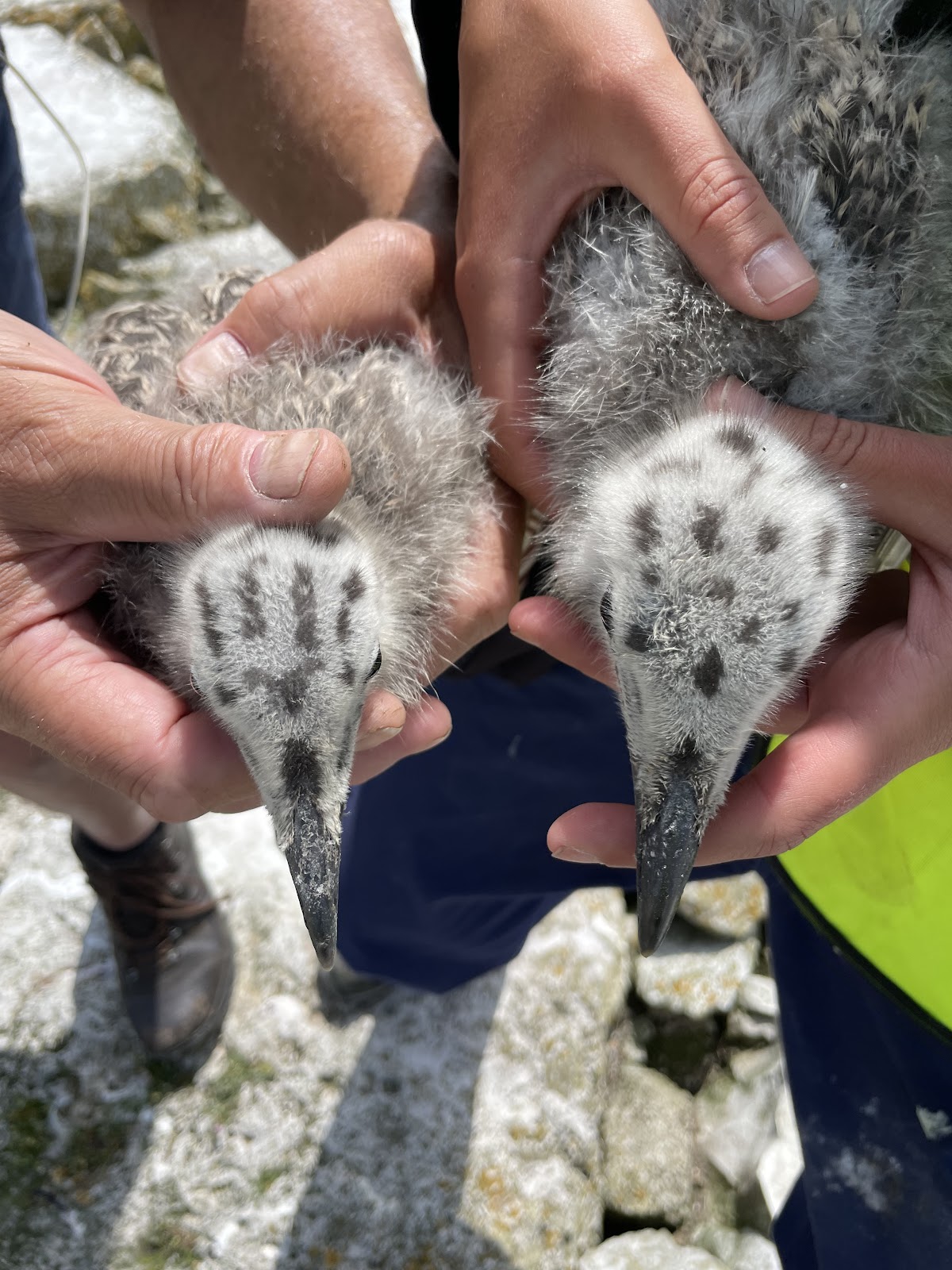
Big challenge: identify the species- L HERGU, R GBBGU

L HERGU, R GBBGU

2 Oystercatcher pulli also ringed this year

Our Darvics are white with red letters and a code similar to P:45Z for the Great black-backed gulls and black with white numbers similar to 687 for the Herring gulls.

Putting a Darvic on a GBBGU

Our email for sightings is  seawaterbirds@gmail.com


We always aim to include a variety of experience in the teams to promote education and learning.

In the last 5 years we lost two complete years' activities to COVID and Highly Pathogenic Avian Influenza (HPAI) and one year was ended early with potential HPAI signs in the colonies.

It is now common for us to find some  previously rung Great black-backed gulls on the Breakwaters. The oldest one seen is 11 years old but they are known to achieve 26 years old. The project has now rung over 600  Great black-backed gulls and nearly 500 Herring Gulls. 

We have a spread of sightings from Lubeck in Germany,  Bay of Txingudi in France and  A Coruña in Spain and this year we have had our first sightings from Ireland and we know of one gull that has managed a trip of over 132 miles within in two days.


P:18C ringed 27/11/19

Transport to & from the Breakwaters is by the Pilot boat

The Team (well, one variation of it!)


Guy Hayden

Saturday, 5 July 2025

Sand martins on the 4th of July

 A team of six did our second mist netting session in front of the sand martin bank on Friday and followed that with some sand martin nestling ringing to complete our mornings ringing.  It meant an early start, with the nets up at 5 am.  We walk the nets, already set, into place in front of the bank, and as we move in birds leaving their nest holes are caught whilst we are on the move.  We were more efficient in getting the nets out this time compared to last, but as always we learnt new lessons for next time.


The team of six looking cheerful despite the early start!

The catch was very good. We limit ourselves to an hour to minimise the disturbance to the colony.  We are planning to continue this at approximately two week intervals, with this being the second catch.  We caught 83 birds.  One of these was a sedge warbler, only the second one for the year so far.  Of the remaining 82 only 6 were birds that hatched this year.  I have read reports from other colonies of first year birds roosting in the colony, but this does not seem to happen much here.  There are reports from local birders of sand martins roosting in reed beds near the tramway line so this may well include our first year birds.  All six were already ringed. 
 
First year bird showing characteristic paler fringes fringes to feathers.

28 of the 76 adult birds caught were retraps, 27 of them were birds we had ringed previously this year.  The 28th was our third French ringed bird.  

French ringed sand martins.  Just as attractive as all the others.

 We will post details of these three encounters when we have the details for this third bird.  This left 48 new adult birds, so adding 49 to the total of breeding adults encountered this season.


The nets just before we finished.

Having packed up from our mist netting session we turned out attention to nestlings.  It is very busy at the moment behind the bank with many pairs bringing up their second broods with the earlier second broods really coming to the ringing stage over the next week or so.  We dealt with 8 broods of youngsters ringing a further 34 chicks.  

Overall an extremely productive morning!